Galilee


Galilee is a small, unincorporated rural community in central Walker County, Texas, located on State Highway 30 approximately five miles west of Huntsville, the county seat. The area, situated near the intersection of SH 30 and Williams Road, developed in the early 20th century as an African American settlement focused on agriculture and education, with roots tied to post-Reconstruction efforts in Walker County. It was named after the biblical region and served as a hub for Black residents in the region, with no recorded population estimates historically, reflecting its modest, dispersed scale.
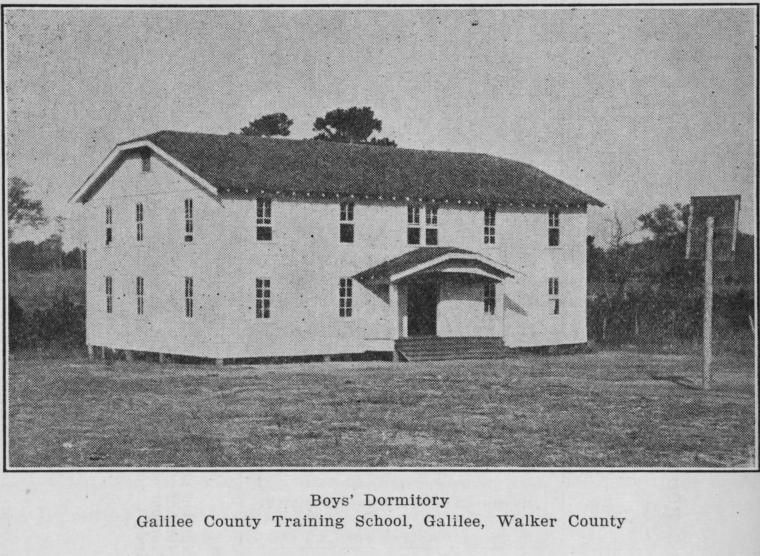
The community's history is inextricably linked to education, particularly the establishment of the Galilee Community School in 1906-1907 by Samuel Walker Houston (c. 1864–1945), a pioneering African American educator and son of Joshua Houston, a former enslaved person owned by General Sam Houston.
Initially housed in a dilapidated 12-by-14-foot hut that had been a private residence, the school served grades 1-6 for local Black children.
Houston, who had studied at Atlanta University and Howard University before returning to Texas, rented the nearby Galilee Methodist Church for classes, paying $4 monthly from his $35 salary.
With community support, he formed a board of trustees (including figures like John Randall, Milton Jones, and Eastern Dickie) that secured a one-acre land donation from Melinda Williams on December 1, 1906, to build a new four-room school with a vocational shop.
Fundraising through events like concerts, bake sales, and baseball games enabled expansion, and by 1914, the first campus building was constructed.
The school evolved into the Sam Houston Industrial and Training School (also known as Houstonian Normal and Industrial Institute or Samuel W. Houston Industrial and Training Institute), a private Rosenwald school offering vocational training in cooking, sewing, woodworking, carpentry, agriculture, music, humanities, and sciences for grades 1-11 (later 1-12).
Additional land (4.5 acres) was acquired for dormitories and workshops, funded partly by the Rosenwald Fund, Slater Fund, and Quaker Fund.
By 1922, enrollment reached 400 students with a dozen teachers, making it one of the leading rural Black schools in East Texas and the first county training school for African Americans in the state.
Houston married fellow teacher Hope G. Harville in 1915, and they resided near the school grounds.
In 1930, at Houston's request, the school consolidated with the Huntsville Independent School District, becoming part of the public system and merging into what became Sam Houston High School, where Houston served as principal until his death in 1945.
A key remnant of the community is the Galilee Cemetery, located on Booker Spur north of SH 30, just west of Booker Road (coordinates: 30.699351, -95.636049).
It contains over 150 burials, primarily from African American families, with the earliest dated graves from the late 19th century, though many are from the 20th century.
Notable interments include members of prominent local families such as Butcher, Hightower, Holloman, Houston, Johnson, Jones, Owens, Pace, and Spivey, with several military veterans (e.g., Pvt Henry Butcher, Sgt Cortland W. Davis, CPL Jesse Jones).
Burials reflect multi-generational ties, including Annie Samuels Houston (1884–1969), possibly related to the educator's family, and others like Brazilia Walker Butcher (1896–1993) and Ella Walker Hightower (1872–1963).
The cemetery underscores the community's African American heritage and connections to early settlers.
Today, Galilee remains a quiet rural area with limited development, integrated into the broader Walker County landscape known for its ties to Sam Houston and African American history.
The school's legacy is commemorated by a Texas Historical Commission marker (No. 13238, erected 2005) at the original site, the Samuel Walker Houston Memorial Museum & Cultural Center in Huntsville, and "The Dreamers" monument (1995) on the grounds of the former Samuel W. Houston Elementary School.
The community does not appear on lists of ghost towns, indicating it persists as a named locality.

Samuel Walker Houston (February 12, 1864–November 19, 1945) was a pioneering African American educator, school founder, and administrator in Texas. Born enslaved in Huntsville, Walker County, Texas, he was the son of Joshua Houston Sr. (a former enslaved person owned by General Sam Houston) and Sylvester Baker (or Lee). After emancipation, he attended public schools in Huntsville and graduated from Hampton Institute in Virginia (1890) and Howard University (1893). He began teaching in rural Texas communities, including Dodge and Galilee, where he established the Galilee Community School in 1907—the first academy for Black students in grades 1–12 in Walker County. Initially a one-room school, it expanded under his leadership to include vocational training, with Houston serving as principal. He formed a Board of Trustees in 1908, including local figures like John Randall, Milton Jones, and Eastern Dickie. Houston remarried on April 28, 1915, to Hope G. Harville, a Tuskegee Institute graduate who taught homemaking at the school; they had three children: Samuel W. Houston Jr. (1916), Helen Hope (1917), and Hyder Hope (1919). Active in community organizations, he was a YMCA director, Texas Centennial Exposition board member, and advocate for Black education. The school evolved into the Houstonian Normal and Industrial Institute by 1923 and later merged with Huntsville ISD in 1931. Houston died in 1945 and is buried in Oakwood Cemetery, Huntsville. His legacy is preserved at the Samuel Walker Houston Memorial Museum & Cultural Center in Huntsville.

John Randall was a key community figure in Galilee, Texas, serving on the Board of Trustees for Samuel Walker Houston's Galilee Community School, established in 1908, alongside Milton Jones and Eastern Dickie. This board supported the school's growth as an educational hub for Black students. A possible match is John Henry Randall (1914–2005), whose funeral was held at Galilee Missionary Baptist Church in Huntsville, suggesting ties to the local African American community. No further details on his personal life or direct military service were found, but his role indicates involvement in early 20th-century education and community development in Walker County.

Milton Jones was another member of the 1908 Board of Trustees for the Galilee Community School, collaborating with John Randall and Eastern Dickie under Samuel Walker Houston. A likely match is Rev. Milton Jones (January 14, 1924–December 10, 2008), a pastor whose services were held at Galilee Missionary Baptist Church in Houston. He was born in Texas and active in the church community. Other Milton Jones records include a 1941-born individual from New Boston, Texas, but no direct Galilee link. His trusteeship highlights his role in advancing Black education in early 20th-century Texas.

Eastern Dickie (possibly Dickey) served on the Galilee Community School's Board of Trustees in 1908 with John Randall and Milton Jones, aiding Samuel Walker Houston in establishing and expanding the institution. Limited personal details are available, but his involvement points to leadership in the African American community of Galilee, Texas, during a time of educational advancement post-emancipation. No birth/death dates or family ties were confirmed in records.

Hope G. Harville (c. 1890s–unknown) was an educator and wife of Samuel Walker Houston, marrying him on April 28, 1915. A graduate of Tuskegee Institute, she taught homemaking at the Galilee Community School, contributing to its vocational programs. They had three children: Samuel Jr., Helen Hope, and Hyder Hope. Her role supported the school's mission for Black education in Walker County. Descendants include granddaughter Hyder Hope Houston, who continued the family legacy.

The Hightower family has deep roots in Walker County, Texas, with ties to Galilee. Key members include Mary Hightower (1886–1961), daughter of Benjamin Hightower Sr. and Jane Nackwhite; Pvt. John W. Hightower (1909–1975), a WWII veteran buried in Galilee Cemetery, married to Robbie Lee Harge; Essie B. Hightower (1923–2024), born in Walker County; Ettree Ross Hightower (1926–1949); and Wilburn T. Hightower (d. 2024). Connections include intermarriages with Holloman (e.g., David Henry Holloman, son of Earl Hightower and Clara Holloman) and Spivey families. They were involved in farming, ministry, and community life in the African American settlements.

The Holloman family is prominent in Huntsville and Galilee areas. Notable members: Emma Jean Glaze Holloman (1913–2013); Lee Roy Holloman (d. 2014), married to Shirley Tyson-Holloman; Henrietta Holloman Mack (1951–2023), daughter of Henry and Emma Jean; David Henry Holloman (1966–unknown), son of Earl Hightower and Clara Holloman; and Gloria Ruth Holloman (1941–2023) from Naples, Texas. They have ties to churches like Galilee Missionary Baptist and community service, with intermarriages linking to Hightower and others.

The Johnson family has connections to Galilee Missionary Baptist Church and community leadership. Key figures: Pastor Vincent Johnson (installed 2024 at Galilee MBC, Houston); Emile Johnson (1939–2015), services at Greater Galilee MBC; Minnie Ola Johnson (1925–2025), honored church member; and Scott Edwin Johnson (1894–unknown), teacher and councilman in Huntsville. Broader ties include historical migrations and church involvement in East Texas African American communities.

The Owens family settled in Grimes and Walker Counties. Members include Ruby Owens (1902–1957); Iris Owens Kennedy (1918–unknown), born in Bedias, Texas; Tony Owens (1936–2024) from San Angelo; and Lee Andrew Owens (1928–2018) from Bryan. They were farmers and community participants, with ties to local churches and historical African American settlements.

Pace family records in Texas include Bolia Pace (1902–1952) from Polk County; Flossie Ethel Spivey (née Pace, 1902–1984), buried in Texas; and Sylvester Pace (1934–unknown) from Longview. Some ties to churches like Galilee Baptist. Broader family history involves farming in East Texas, with possible intermarriages (e.g., to Spivey).

The Spivey family has Walker County connections. Key individuals: Pvt. Robert L. Spivey (1896–1952), WWI veteran buried in Texas; Ira Lee Spivey (1918–1976), daughter of John and Mary Hightower Spivey; Flossie Ethel Spivey (1902–1984, née Pace); Rev. Washington T. Spivey; and Curtis Lorraine Spivey (1918–1986). They intermarried with Hightower and Pace families, involved in farming and military service in East Texas African American communities.

Military Veterans: Pvt. Henry Butcher, Sgt. Cortland W. Davis, and CPL Jesse Jones of Galilee, TexasLimited specific records exist for these veterans tied directly to Galilee, but contextual matches suggest community connections:Pvt. Henry Butcher: Possible WWII veteran referenced in broader Texas military histories or scrapbooks, but no explicit Galilee link. May relate to local African American enlistees.
Sgt. Cortland W. Davis: No direct records found; potential ties to Vietnam or other wars via veteran lists, but unconfirmed for Galilee.
CPL Jesse Jones: Likely matches include CPL Jesse Jones in WWII rosters (e.g., 84th Infantry Division) or Pastor Emeritus Jesse Gene Jones (d. 2025), a veteran from Houston with possible Galilee roots. Another is Jesse D. Jones, a US Navy veteran and job developer in Houston. A 103-year-old East Texas WWII veteran named Jesse Jones reflects on service, possibly related.

These may represent African American veterans from Walker County, contributing to a rich East Texas military heritage, including families with multi-generational service.

Connections Among the Names, Families, and Veterans:  These individuals and families are interconnected through the African American community in Galilee, Texas (Walker County), a post-emancipation settlement focused on education and self-sufficiency. Samuel Walker Houston's school was central, with trustees like Randall, Jones, and Dickie providing leadership. Hope G. Harville was integral as his wife and educator. Families like Hightower, Holloman, Johnson, Owens, Pace, and Spivey share intermarriages, church affiliations (e.g., Galilee Missionary Baptist), and burials in Galilee Cemetery. Veterans like Butcher, Davis, and Jones reflect the area's military contributions, often from farming backgrounds. The legacy includes resilience against segregation, with ongoing church and educational ties in East Texas.


Galilee was on State Highway 30 five miles west of Huntsville in central Walker County. It was the first home of the Houstonian Institute for Negroes, which was founded by Samuel Walker Houston and became known throughout the South for its industrial department. The school was eventually consolidated with a black high school in Huntsville. Galilee was a dispersed community in 1990.  TSHA
Texas State Historical Association
https://www.tshaonline.org/handbook/entries/galilee-tx-walker-county

TX Almanac
https://www.texasalmanac.com/places/galilee-0

Find a Grave
https://www.findagrave.com/cemetery/2293822/galilee-cemetery