
Moore's Grove

Moore's Grove (also spelled Moore Grove or Moores Grove) is a defunct historical rural community in southern Walker County, Texas. Established in the 1850s, it was an agricultural settlement with a church and school but no formal town, store, or post office. Named after brothers Absalom A. and James W. Moore, the community was closely tied to the neighboring East Sandy Community, sharing resources like a church and schoolhouse. Settlement in the area began in the early 1830s, reflecting broader pioneer migration into East Texas. By the early 20th century, the community had declined, with the school merging into Moore's Grove School around 1913. Today, it no longer exists as a populated place, with only a small cemetery as a remnant.

Location and Geography:
Moore's Grove is located in southern Walker County, approximately 7-8 miles southwest of Huntsville and near New Waverly, on the south bank of the middle section of East Sandy Creek. Coordinates are approximately 30.574°N, 95.542°W. The creek rises two miles north of New Waverly (30°35'N, 95°29'W) and flows west for 11 miles to Lake Conroe near the Montgomery County line (30°33'N, 95°37'W), within the Sam Houston National Forest boundary. The terrain is gently rolling to sloping, with sandy and loamy soils supporting woodlands of loblolly pine, shortleaf pine, sweetgum, water oak, elm, pecan, post oak, black hickory, willow oak, and blackgum along the creek banks.

History:
Anglo-American settlement in the vicinity started in the early 1830s, aligned with the development of nearby Huntsville (founded 1836) and other East Texas communities. The area attracted families from Mississippi and elsewhere, including the Sandel and Powell families in the 1850s, who helped establish the East Sandy Community. Rev. Peter W. Sandel (1806-1866) purchased land in 1851, and Oliver Powell (1815-1892) followed suit. These Methodist families built a small building for church services and a school, serving the agricultural settlement focused on farming.

The community was named Moore's Grove in 1848 after brothers Absalom A. Moore and James W. Moore. By the 1850s, Moore's Grove and East Sandy were established as neighboring rural hubs. In the 1880s, a Baptist congregation began sharing the church building. The school operated until around 1913, when it consolidated with Moore's Grove School. No population data is recorded, as it was unincorporated and rural. The area declined in the 20th century due to consolidation and economic shifts, similar to other small Walker County communities like Waverly and Phelps.

A Texas Historical Commission marker (No. 13088, erected 2005) for the East Sandy Community commemorates the site's history, noting its role as a settlement center.

Cemetery:
Moore's Grove Cemetery is a small burial ground located on the north side of FM 1374, approximately 2 miles west of IH-45 at the New Waverly exit (near 30.574°N, 95.542°W). It is enclosed by a chain-link fence and contains only two marked graves, with potential unmarked ones. The cemetery is listed in Walker County records but has limited documentation. No specific burial details are widely available, though nearby East Sandy Cemetery (adjoining the historical church/school site) holds graves from the 1860s onward, including the first marked burial of twin daughters of A.A. Moore in 1861, and possibly earlier unmarked Dunn family graves. Families associated with the area, such as Moore, Sandel, and Powell, are interred in East Sandy rather than Moore's Grove. The cemetery remains a minor historical feature, with no active association or maintenance details noted.

Marked Graves
Only two documented; specific names not listed in records.
Location
North side of FM 1374, near East Sandy Creek; chain-link fenced.
Related Burials
Moore family members (e.g., James Washington Moore, 1820-1874) in nearby East Sandy Cemetery.

Distinction from Other Sites:
Mossy Grove: This is a separate defunct community in northern Walker County, on State Highway 75, about 14 miles north of Huntsville. Established by the 1930s, it had a school (consolidated with Huntsville in 1937) and scattered farms. By the 1940s, only a few houses remained, and in 1990, it had no rated population. It should not be confused with Moore's Grove, despite similar names in some lists (possibly due to spelling variations). Mossy Grove has no documented cemetery or church tied to it in historical records.

East Sandy Community:
Adjacent and intertwined with Moore's Grove; shared church, school, and cemetery. The historical marker is at 30°34.987'N, 95°33.899'W, near the former settlement center.

No connections to the prehistoric "Mossy Grove Tradition" (a cultural term for late prehistoric groups in southeast Texas and Louisiana).

Other Moore-related sites in Texas (e.g., Moore Grove in Grimes County) are unrelated.

Demographics and Modern Status:
No historical or current population figures exist for Moore's Grove, as it was a small, unincorporated rural area. Walker County overall had a 2020 population of 76,400, with Huntsville as the main hub. The site remains rural and undeveloped, part of the Piney Woods region, with no active infrastructure. It attracts occasional interest from genealogists and historians due to its ties to early settlers, but there are no modern communities, businesses, or events associated with it.

Sources and Further Reading:
Information is compiled from historical markers, almanacs, county records, and genealogical sites. For more, consult the Texas State Historical Association's Handbook of Texas, Texas Almanac, Walker County Historical Commission, or Find a Grave entries for related cemeteries.

Absalom A. Moore
Absalom Autry Moore was born on April 20, 1818, in Georgia, and died on December 6, 1893, in Walker County, Texas, at age 75. He was the son of George Hudspeth Moore. Absalom settled in Walker County around the 1840s and was a key figure in establishing the rural community of Moore's Grove (also known as Moore Grove), named in 1848 after him and his brother James W. Moore. The area, located on the south bank of East Sandy Creek, included a church and school but never developed into a formal town or had stores. Absalom's family was involved in agriculture, and the first marked grave in the nearby East Sandy Cemetery (1861) belongs to his twin daughters. He lived in Walker County for about 20 years and registered for military service in 1846, likely related to the Mexican-American War.

Known family:Father: George Hudspeth Moore.
Siblings: Included James W. Moore (co-namesake of Moore's Grove); possibly others, as references to "Moore brothers" suggest a group migration.
Children: Twin daughters (buried 1861 in East Sandy Cemetery); other descendants not detailed in sources.

James W. Moore
James W. Moore was the brother of Absalom A. Moore and co-namesake of Moore's Grove, established in 1848 in Walker County, Texas. The community focused on agriculture, with a church and school on the south bank of East Sandy Creek. No further personal details (e.g., birth/death dates) were found, but he was part of the Moore brothers' settlement group. Unrelated modern figures (e.g., Rev. James W. Moore, a 20th-century author and pastor) do not connect.

Rev. Peter W. Sandel
Rev. Peter Warren Sandel was born on September 8, 1806, in Orangeburg County, South Carolina, and died on April 18, 1866, in Walker County, Texas, at age 59. He was a Methodist circuit rider who organized Muddy Springs Methodist Church near McComb, Mississippi (still standing today). He migrated from Mississippi to Texas around 1851, buying property in the East Sandy community near Huntsville. He served as a private in Company B, 24th Regiment, Texas Cavalry (Wilkes'/2nd Texas Lancers), CSA. He was a member of the Founders and Patriots of the Republic of Texas, tracing lineage to Isaac Tabor. His land became the site of East Sandy Cemetery, church, and school. Probate records are in Book E, page 325, Huntsville, Walker County.

Family:Parents: Son of George Henry Sandel; grandson of John Peter Sandel (immigrated to South Carolina in 1752).
Spouses: First, Winifred L. Tabor (born 1811; married 1826; died 1842 in Pike County, Mississippi). Second, Louisa J. Winborn (married 1844).
Children (with Winifred): William Fletcher (1827), James Franklin (1829–1845), John Oliver (1831), Levisa Elizabeth (1832–?), Isaac Benson (1834–1836), Eliza Ann (1835–1886, married J.T. Vick), David Wiggins (1839–1862), Peter Tabor (1842).
Children (with Louisa): Mary M. (~1847), Thomas Griffin (1849–1864).
Bible records detail baptisms and family events, donated by descendant Mary E. Sandel.

Oliver Powell
Oliver Powell was born on March 12, 1815, and died on May 16, 1892, at age 77. He migrated from Mississippi to Walker County, Texas, in the 1850s with his wife, Caroline Quinn, and their children. He bought land in the East Sandy community, contributing to its establishment as an agricultural settlement. The Powells were Methodists and helped form a local congregation using a building that doubled as a school. In 1903, his descendants (J. Rodney Powell and Noah R. Powell) were trustees in a land sale for the community, including the cemetery and church site. He is buried in East Sandy Cemetery, New Waverly, Walker County.

Dunn Family of Moore's Grove, Texas in Walker CountyThe Dunn family is mentioned in oral histories of the East Sandy community (adjacent to Moore's Grove) in Walker County. According to interviews with John Oliver Vick (1869–1959), earlier unmarked graves in East Sandy Cemetery (pre-1861) may belong to Dunn family members. The community school merged with Moore's Grove School around 1913. No further details on specific individuals or migrations were found, but they were likely early settlers in the agricultural area.

Key interpretations:  Moore Brothers Migration: References to "Moore brothers" align with Absalom A. Moore and James W. Moore (possibly others) settling in Walker County around 1848 to establish Moore's Grove. Some brothers may have returned east, as early Texas settlements faced hardships (e.g., Native American threats, as in prior McAdams family histories).

"3 corn grant": Likely a transcription error for "three league grant" or "land grant." Texas Republic land grants were often in leagues (one league ≈4,428 acres). Absalom and brothers received headrights or purchased land in the 1840s–1850s.
From Alabama: Absalom was born in Georgia, but related families (e.g., Baines, Carroll, Stephens) migrated from Alabama to Texas in the 1830s–1880s, often with land certificates. Some Moores had Alabama ties in broader genealogies.

"1800 irons of rail": Possibly "1800 bars of iron rail," referring to materials for fencing, railroads, or farming tools brought west. Early Texas railroads (e.g., 1852 Galveston & Red River, involving a Francis Moore) used iron rails, and settlers transported supplies.


East Sandy Creek, a perennial stream, rises two miles north of New Waverly in southern Walker County (at 30°35' N, 95°29' W) and flows west for eleven miles to its mouth on Lake Conroe, near the Montgomery county line (at 30°33' N, 95°37' W). The stream lies within the boundary of the Sam Houston National Forest. It traverses gently rolling to sloping terrain surfaced by sandy and loamy soils that support woods of loblolly pine, shortleaf pine, sweetgum, water oak, elm, pecan, post oak, black hickory, willow oak, and blackgum along its banks. Settlement in the vicinity began in the early 1830s. The Moore's Grove and East Sandy communities were both established on the south bank of the middle creek during the 1850s. Texas Almanac


Click Photo for History

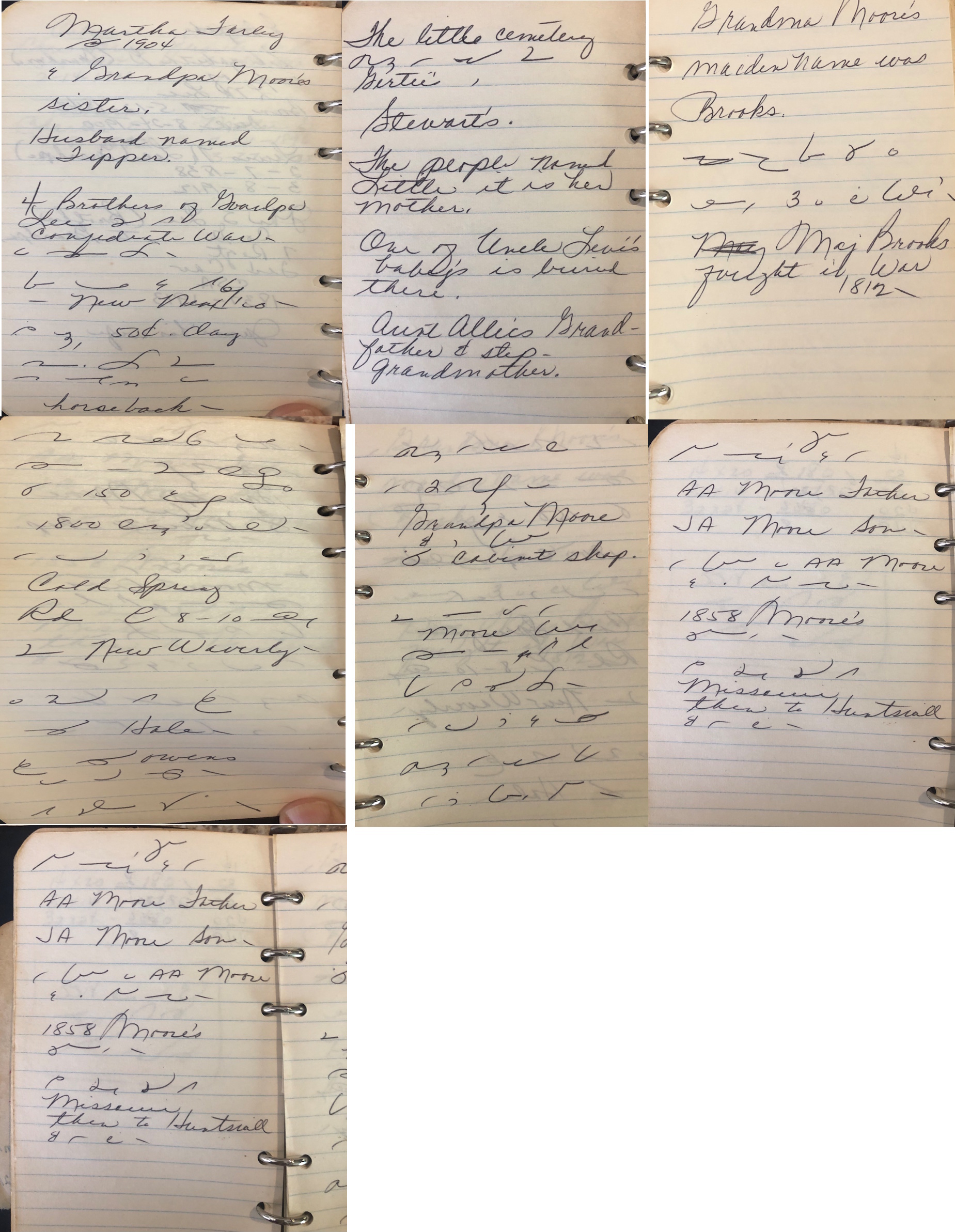
Memo from an Ancestor of the Moore Family

(1)  Dr Moore's father was
A A Moore father
J A Moore son
The brother of A A Moore was a Dr Moore
1858 Moore's father

They since went to Missouri then to Huntsville and then here.

(2)  Arrives with note are the 2 grandfathers are Grandpa Moore and his brother had a cabinet shop.
Soon more of the Moore's brothers came in to Texas but they went back.
Arrives with note then his bringing down (3) corn grant by a letter came from Alabama with 150 slaves, 1800 irons of rail.
This will help us in the Cold Spring Rd around 8 - 10 miles from New Waverly.

He sent 2 people name Hall.  People name Owens are there now.  It is still standing.

(4)  Grandma Moore's maiden name was Brooks.  Mr Brooks since he remembered 3 of his brothers Major Brooks fought in 1812.

(5)  The little cemetary arrives with note from Gertie.
Stewart's.
The other people named Little it is her mother.
One of Uncle Levi's baby's baby's is buried there.
Aunt Allies grandfather + step-grandmother

(6)  Martha Farley dated 1904 was Grandpa Moore's sister.  Husband named Tipper.

4 brothers of Grandpa Lee sent to Confederate War.  All came back.

Brought letter was discharge in New Mexico.  They recieved 50 cents a day.
Coming back from New Mexico on horseback.


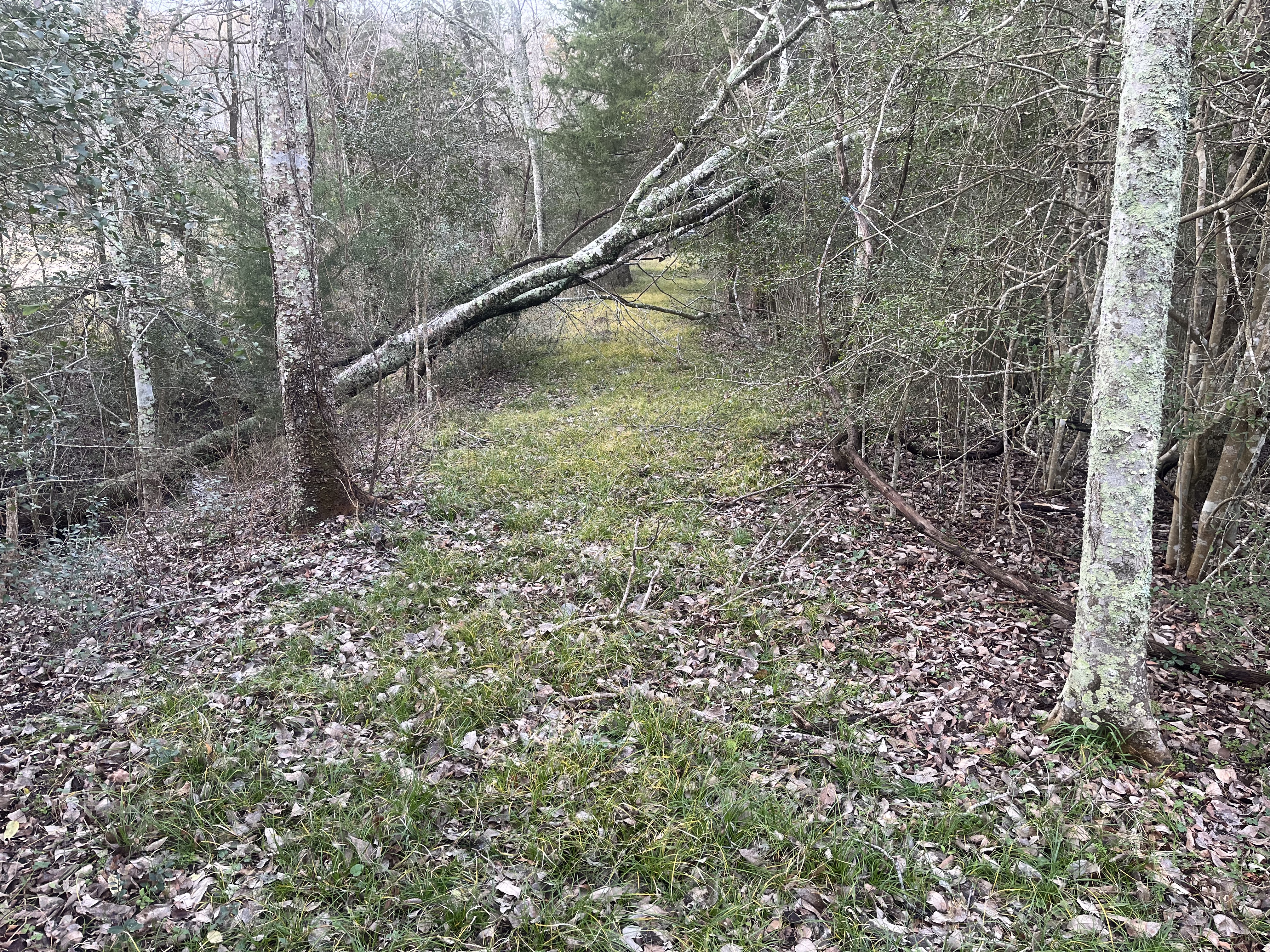
The Railroad Mound as discussed above, located in Old Waverly TX


Texas Almanac
https://www.texasalmanac.com/places/moore-grove

RoadsideThoughts
https://roadsidethoughts.com/tx/moore-grove-xx-walker-profile.htm

Anyplace America
https://www.anyplaceamerica.com/directory/tx/walker-county-48471/locales/moores-grove-lookout-1382322/

Find a Grave
https://www.findagrave.com/cemetery/2377566/moore's-grove-cemetery