Walker County General

Overview of Early Walker County, Texas

Walker County, located in the southeastern portion of Texas, encompasses approximately 828 square miles of gently rolling terrain, forested in the east and opening into prairies in the west. It is bounded by the Trinity River to the north and east, with Huntsville serving as the county seat since its formation. The area's early history spans from prehistoric Native American habitation through Spanish and French exploration, Anglo-American settlement in the 1830s, and rapid growth tied to cotton agriculture and river trade during the mid-19th century. Formed in 1846 from Montgomery County, the county's population grew from about 2,700 in 1847 to over 8,000 by 1860, driven by immigration from the U.S. South. Its name honors Samuel H. Walker, a Texas Ranger, reflecting the region's frontier spirit. Early economy centered on subsistence farming, cattle, and cotton, with steamboat ports facilitating trade to Galveston. By 1900, railroads and lumber mills had transformed it, but the pre-1900 era defines its foundational identity as a cotton kingdom amid Native displacement and Civil War turmoil.Native American Inhabitants
The earliest known residents were the Cenis (also spelled Assinay or Hasinai) Indians, a Caddoan group who lived between the Trinity and San Jacinto rivers from at least the 16th century. They were semi-sedentary farmers cultivating corn, beans, and squash, which they traded with western tribes like the Comanches, Lipans, and Tonkawas for horses, hides, and Spanish goods. The Cenis village near present-day Huntsville was a key intertribal trade hub, where forest-dwelling groups (Alabama-Coushatta, Neches, Nacogdoches) exchanged with plains nomads. They were largely exterminated by 1780 due to diseases, intertribal warfare, and displacement from eastward-migrating American tribes (e.g., Osage, Quapaw) pushed by European expansion.In the northern part of the county, the Bidai (or Bedias) Indians, an Atakapan-speaking hunter-gatherer people, occupied lands along Bedias Creek at the Trinity-Brazos confluence. They subsisted on fishing, foraging wild plants, and occasional coastal trade for shellfish, but suffered devastating losses from a 1776–77 epidemic that halved their population. The Bidai were known for peaceful interactions with early Europeans but were ultimately displaced by Anglo settlers in the 1830s. A Cherokee village also existed near Huntsville in the early 1800s, though transient. These groups left archaeological traces like pottery and trade artifacts, but no permanent sites remain due to later development.
Tribe/Group
Cenis (Hasinai)
Central/southern areas, near Huntsville
Corn farming, trade hub
Exterminated by 1780 via disease/war
Bidai (Bedias)
Northern, along Bedias Creek
Hunter-gatherers, fishing
Epidemic in 1770s; displaced by 1830s
Cherokee (transient)
Near Huntsville
Village-based farming
Removed west in 1830s Trail of Tears

European Exploration and Early Settlement
Spanish explorers first traversed the region in 1542 under Luis de Moscoso Alvarado during Hernando de Soto's expedition, seeking a route to the Mississippi. In 1687, French explorer René-Robert Cavelier, Sieur de La Salle, crossed the area en route to the Gulf, prompting Spanish retaliation. In 1689, Alonso De León led a military expedition, establishing La Bahía Road—a cleared path from East Texas to the coast that passed through present-day Walker County and facilitated later colonization.Anglo settlement began in the early 1830s amid Mexico's empresario system. The area fell within Stephen F. Austin's colony, part of the Municipality of Washington (later Washington County). By 1835, squatters and traders arrived, drawn by fertile Trinity River bottoms. Pleasant Gray and his brother Ephraim established a trading post in 1835 on the site of Huntsville (named for their Alabama hometown), trading with local Indians for deerskins and horses. Steamboat navigation on the Trinity from 1838 onward spurred growth, enabling cotton export to Galveston. Early settlers included Scots-Irish and Southerners, with land grants averaging 640 acres. By 1840, small farms dotted the landscape, but Indian raids persisted until the 1840s.Formation of the CountyWalker County was created on April 30, 1846, by the First Texas Legislature, carved from northern Montgomery County. Initially named for Robert J. Walker, a Mississippi senator who championed Texas annexation to the U.S., the name changed in 1863 to honor Samuel Hamilton Walker (1817–1847), a Texas Ranger captain killed in the Mexican-American War. Walker, born in Maryland, arrived in Texas in 1835, fought at the Alamo siege, and led Ranger companies against Comanches and Mexicans; his exploits, including scouting for Zachary Taylor, made him a hero. Huntsville was selected as the seat due to its central location and Gray brothers' donation of 120 acres.The first county court convened on July 27, 1846, in a log cabin, with Milton Estill as chief justice, Isaac McGary as clerk, William Reeves as sheriff, and commissioners James Mitchell, Benjamin W. Robinson, Elijah S. Collard, and D. J. Tucker. A wooden jail was built in 1847 on land donated by Henry Sheets; the courthouse followed in 1848 on Pleasant Gray's gift. Early governance focused on road-building, ferries, and Indian affairs.Early Towns and Settlement PatternsSettlement clustered along the Trinity River for trade access. Key early communities included:Huntsville: Founded 1835 as a trading post; by 1850, it had stores, a hotel, and the Huntsville Item newspaper (est. 1852). Grew as administrative center.
Cincinnati: Est. 1838 by James DeWitt as a steamboat port; became the commercial hub by 1840s, shipping cotton via stage roads from Washington-on-the-Brazos to Nacogdoches.
Carolina: Oldest river town (1835), a steamboat landing predating Cincinnati; site of John H. Cummings' 1835 land league.
Newport, Tuscaloosa, Wyser's Bluff: River ports for cotton ginning and trade; declined post-1860s with railroads.

By 1850, population was 3,964 (32% enslaved); it doubled to 8,191 by 1860 (50% enslaved), with most farms under 50 acres. Immigrants were predominantly from Alabama, Tennessee, and Virginia.Ghost towns like these highlight boom-bust cycles: four northern Trinity sites (Carolina, Cincinnati, etc.) thrived on steamboats but faded after 1871 railroads bypassed them.Economy and AgriculturePre-1900 economy relied on agriculture and nascent industry:Agriculture: Corn and cotton dominated. In 1850: 102,000 bushels corn, 1,873 cotton bales, 18,000 cattle. By 1860: 315,000 bushels corn, 11,850 bales cotton, 14,000 cattle. Cotton fueled slave-based plantations; 376 of 646 white families owned slaves. Post-war decline (5,524 bales in 1870) gave way to sharecropping; by 1880, 6,441 bales from 20,000 acres.
Livestock: Open-range cattle and hogs; milk cows numbered 4,300 in 1850.
Industry/Trade: Steamboats moved goods; Texas Penitentiary (est. 1849 in Huntsville) produced cotton textiles (12,000 yards/day by 1859). Lumber emerged in 1870s with railroads, but pre-1900 focus was agrarian.
Education/Religion: 10 public schools by 1860 (400 students); Austin College (1840s) and Andrew Female College in Huntsville. Methodist, Baptist, and Presbyterian churches organized early.

Key Events
1830s–1840s: Indian raids; Treaty of 1844 with Bidai/Caddo ends hostilities.
1853: Yellow fever epidemic devastates Cincinnati.
Civil War (1861–65): County supplies Confederate units (e.g., Walker's Texas Division); slave population peaks at 8,663 (1864). Minimal fighting, but economic strain.
1867: Yellow fever in Huntsville kills dozens.
Reconstruction (1867–71): Tensions erupt; 1871 murder of freedman Sam Jenkins by whites leads to Capt. Leander H. McNelly's investigation, arrests, courtroom shootout, and 60-day martial law under Gov. Edmund J. Davis. Freedmen's settlements form for Black farmers.

Museums and Markers
Houston's Steamboat House (1847) and Raven Hill home in Huntsville symbolize his era.Historical Sites and Markers
Walker County Courthouse (1858): Greek Revival; National Register.
Texas Prison Museum: Artifacts from 1849 penitentiary, first in Texas.
Sam Houston Memorial Museum: Preserves his homes, law office.
Gibbs-Powell House (1862): Greek Revival museum with Civil War artifacts.
Markers: County creation (Huntsville); Samuel Walker (various); Cenis Indians; Bidai sites; La Bahía Road.

For deeper dives, consult "An Early History of Walker County, Texas" (Sam Houston State Univ. thesis) or TSHA Handbook. Modern discussions on X highlight ongoing preservation, like Gibbs-Powell exhibits.


Early Residents and Shapers of Walker County

Luis de Moscoso Alvarado
Luis de Moscoso Alvarado did not establish a permanent residence in what became Walker County, Texas. As a Spanish explorer and successor to Hernando de Soto, he led an expedition that passed through the region in 1542, marking one of the earliest European explorations of the area. His group interacted with local Indigenous groups, such as the Cenis (Assinay and Hasinai tribes), but there is no evidence of long-term settlement or residence by Alvarado himself.

Alonso De León
Alonso De León did not reside in Walker County but conducted expeditions that traversed the area. In 1689, as a Spanish general, he was dispatched to East Texas by the Viceroy of New Spain to counter French incursions. His men cleared a path that became La Bahía Road, with a portion passing through present-day Walker County. This route facilitated later travel, but De León's activities were exploratory, not residential. He is noted for establishing the first Spanish mission in East Texas (San Francisco de los Tejas) in 1690 and blazing trails across Texas.

Pleasant Gray
Pleasant Gray was a foundational resident and founder of Huntsville in Walker County. Around 1835–1836, he and his brother Ephraim established a trading post on the site, naming it after their former home in Huntsville, Alabama.  Gray built his log home on the northwest corner of the present courthouse square and operated the trading post across the street near the current courthouse location.  While residing there, his wife Hannah gave birth to their son David, the first child born in Huntsville. In 1846, Gray and his wife donated land for the county courthouse.  The Grays ran the business for only a few years before selling lots, including one to Gibbs Brothers in 1848. Gray descended from English and Scots-Irish colonists who migrated from Virginia and the Carolinas.

Ephraim Gray
Ephraim Gray, brother of Pleasant Gray, was an early resident and co-founder of Huntsville. He assisted with the trading post established around 1835–1836 and lived just north of the spring near the site. On June 9, 1837, he became the first postmaster of Huntsville. The trading post was well-positioned for regional trade with local Indigenous groups and settlers.

Robert J. Walker
Robert J. Walker did not reside in Walker County or Texas. The county was originally named for him in 1846 due to his role as a U.S. Senator from Mississippi who introduced the resolution for Texas' annexation to the United States.  In 1863, during the Civil War, the Texas Legislature renamed it for Samuel Hamilton Walker because Robert J. Walker supported the Union.

Samuel Hamilton Walker
Samuel Hamilton Walker had no documented residence in Walker County. The county was renamed in his honor in 1863 for his service as a Texas Ranger and Mexican War veteran. Born in Maryland in 1817, he arrived in Texas in 1842, fought in the Mier Expedition, and co-designed the Walker Colt revolver. He died in 1847 during the Mexican War.

Milton Estill
Milton Estill resided in Walker County from at least 1846 until after 1880. As a Cumberland Presbyterian minister, he served as the county's first chief justice in 1846. Around 1840, he constructed Huntsville's earliest schoolhouse.  In 1847, he pastored the First Presbyterian Church, overseeing the erection of a small wooden church building. By 1880, the census lists him as a 72-year-old widower teaching school in Walker County and serving as chaplain of the Texas State Penitentiary in Huntsville (though he did not live at the facility). Born around 1807 in Kentucky, he moved to Texas around 1840.

Isaac McGary
Isaac McGary resided in the Huntsville area of Walker County from at least 1846 until his death in 1866. He served as the first county clerk from 1846 to 1852. Born in 1800, he arrived in Texas in January 1830, received a league of land, and fought at the Battle of San Jacinto. Previously sheriff of Montgomery County in 1843, he helped organize Walker County.  In 1854, he sold land for the Baptist Church in Huntsville. Probate records from 1847 show family connections in Walker County.

William Reeves
William Reeves resided in Walker County around 1846–1850 or later. He served as the county's first sheriff in 1846. The 1850 U.S. Census Slave Schedules list him owning 13 slaves in Walker County. No further details on his personal life or exact duration of residence were found.

James Mitchell
James Mitchell resided in Walker County from 1833 until his death in 1870. He arrived under a Mexican land grant and helped found the county in 1846, serving as one of its first commissioners. With his wife Calpernia Franklin, he established the Mitchell House and Inn on the Old San Antonio Road (El Camino Real), which served as a rest stop for travelers and an area post office from about 1840 to 1850. They had 11 children and were buried nearby.

Benjamin W. Robinson
Benjamin W. Robinson resided in or near Huntsville, Walker County, from at least 1846 until his death in 1875. He served as one of the first county commissioners in 1846. He received title to a league of land in Walker County and is listed in the 1870 census as residing in Texas. Probate records from 1874 reference him living in the area.

Elijah S. Collard
Elijah S. Collard resided in Walker County from 1840 until his death in 1846. Born in 1778 in Virginia, he moved to the area and was selected as a county commissioner when Walker County was established in 1846. A veteran of the War of 1812 and the Battle of San Jacinto, he surveyed much of the region and donated 200 acres for the town of Montgomery (adjacent to Walker County). Married to Mary Stark, he had 11 children and is buried in Gourd Creek Cemetery near New Waverly, with a Texas historical marker.

D. J. Tucker
D. J. Tucker resided in Walker County around 1846. He served as one of the first county commissioners, participating in their initial session on July 27, 1846, in Huntsville.  No additional details on his life, activities, or duration of residence were identified.

Henry Sheets
Henry Sheets resided in Walker County around 1846. Along with his spouse, he donated property for the county jail in 1846, with construction completed in 1847. No further personal or residential details were found.

James DeWitt
James DeWitt resided briefly in Walker County from around 1838 until his death in late 1838 or 1839. A veteran of the Battle of San Jacinto, he established the port town of Cincinnati on the Trinity River in 1838, which became a leading commercial center and ferry crossing on the stage road from Houston to Dallas. His wife, Sarah Ann, later married Frederick Pomeroy.

John H. Cummings
John H. Cummings resided in northeastern Walker County from 1835 onward. On January 5, 1835, he received a league of land from the Mexican government, where the settlement of Old Carolina was founded at the mouth of Carolina Creek on the Trinity River. This area became an early settlement point.

Sam Houston
Sam Houston resided in Walker County, primarily in Huntsville, from 1847 until his death in 1863. In 1847, he purchased a 200-acre property and designed the Woodland Home, where he lived with his family until 1859. As the first and third president of the Republic of Texas and later governor, he divided time between politics and family life. He died in the Steamboat House in Huntsville on July 26, 1863, and is buried in Oakwood Cemetery. The site is now part of the Sam Houston Memorial Museum.

Capt. Leander H. McNelly
Leander H. McNelly did not have a permanent residence in Walker County but conducted operations there. In February 1871, as captain of the State Police, he arrested four White men in Walker County for murdering a freedman, during which he was wounded by their friends; three were convicted. Born in 1844 in Virginia, he lived mainly in Washington County, Texas, and died there in 1877.

Jacob H. Shepperd
Jacob H. Shepperd resided in Walker County until his death in 1872. A soldier in the Texas Revolution who received a league of land, he founded Shepherd's Valley (also spelled Shepperd's Valley) around 7.5 miles west of Huntsville. Born in 1814 in Surry County, North Carolina, he is buried near Black Jack Cemetery in Walker County.

Henderson King Yoakum
Henderson King Yoakum resided in Walker County from October 1845 until around 1856. Admitted to the Texas bar in December 1845, he lived in Huntsville, where he practiced law and served as mayor in 1846. In the early 1850s, he built a center hall log home at Shepherd's Valley (about three miles east of Huntsville on Four Notch Road at U.S. Highway 190), where he wrote his seminal "History of Texas from Its First Settlement in 1685 to Its Annexation to the United States in 1846," published in 1855. A friend of Sam Houston, he divided time between law and writing. The 1850 census lists him in Huntsville with his wife Eveline Cannon and family. He died in 1856 in Houston County but is associated with Walker through his home and work.


Walker County Indigenous history

Prehistoric and Pre-Contact Period:
Archaeological evidence suggests human habitation in the Walker County area dates back thousands of years, with Indigenous peoples adapting to the region's rich resources, including forests, rivers, and wildlife. The area, situated at the edge of the southern pine forests and the plains, served as a natural hub for intertribal trade and interaction. Permanent fresh water sources like the Trinity and San Jacinto rivers, along with abundant nuts (walnut, hickory), fruits (persimmon), fish, shellfish, waterfowl, and game, supported semi-sedentary lifestyles.

Major Indigenous Tribes and Their Lifestyles
Several tribes inhabited or frequented Walker County, each with distinct cultural practices:

Cenis (also known as Assinay, Hasinai, or Caddo-related groups): These were among the earliest documented residents, occupying lands between the Trinity and San Jacinto rivers. They lived in villages along the Trinity River, including a main village near the later site of Carolina. Known for their agricultural prowess, they cultivated corn and traded it with western tribes for horses, hides, and Spanish goods. Their dwellings were tall, beehive-shaped cabins (40-50 feet high) made of grass or reeds, housing two families with raised beds around a central fire. The Cenis were described as hospitable and gentle, supporting large populations through farming and trade.

Bidai (also spelled Bedai, Bedias, or Bidais): This tribe resided in the northern and northwestern parts of Walker County, particularly along Bedias Creek at its confluence with the Trinity River. Part of the broader Atakapan (Atakapa) linguistic group and related to the Akokisa band, they lived a more marginal existence as hunter-gatherers, supplemented by fishing and limited farming. They inhabited thatched huts and occasionally traveled to the coast for trade.  Their principal village was at the creek's mouth, and they were often raided by more aggressive tribes, keeping their numbers low. Archaeological finds, such as two skeletons uncovered in 1954 on a ranch in Huntsville, suggest possible Bidai burial grounds in the area.

Comanche: Nomadic and warlike plains tribes who frequently entered Walker County from the northwest for raids and trade. They allied with the Cenis for commerce, exchanging goods like pottery, pelts, pine knots, bear grease, robes, and mustang ponies at sites near present-day Huntsville. Other trading partners included the Alabama-Coushatta, Neches, Nacogdoches, Lipan, and Tonkawa tribes.

Cherokee: There was reportedly a Cherokee village on the site of present-day Huntsville, with another possible settlement about 2 miles south on the old Sterne property, where pottery and arrowheads have been found. However, evidence for the latter is circumstantial and unconfirmed.

Other Groups: To the northeast, branches of the Caddo roamed near the Trinity River.

Tonkawa and Comanche groups intermittently visited from the northwest.

The Bidai sometimes imitated Caddo village life, indicating cultural exchange.

European Contact and Interactions
European exploration began in the 16th century, disrupting Indigenous lifeways through disease, trade shifts, and conflict:In 1542, the Spanish expedition led by Luis de Moscoso Alvarado (successor to Hernando de Soto) traversed the region, camping north of the Trinity in adjacent areas before crossing into Walker County territory. They captured Bidai individuals as guides and sent scouts who encountered impoverished Indigenous groups in huts with scant possessions. French explorer René Robert Cavelier, Sieur de La Salle, crossed the area in 1687, possibly traversing from southwest to northeast via landmarks like the San Jacinto River and White Rock Creek. The Cenis were first documented by the French in 1686. In 1689, Spanish captain Alonso De León responded to French incursions by blazing La Bahía Road through Walker County. From 1774 to 1779, the Spanish established Bucareli on the Trinity River (possibly near Robbins Ferry or a ranch in Huntsville), an outpost with about 400 settlers aided by local Bidai. The settlement thrived on fertile land but was repeatedly raided by Comanches, leading to its abandonment for Nacogdoches.

Decline, Displacement, and Removal
The late 18th and early 19th centuries brought devastating changes:An epidemic in 1776-1777 halved the Bidai population. Survivors integrated with Caddo and Atakapan groups. Around 1780, the Cenis were annihilated in a battle on the Trinity River by invading tribes displaced westward by American expansion along the Mississippi. Comanche raids continued, targeting Bidai villages and Spanish settlements. By the early 1830s, Anglo-American settlers like Pleasant and Ephraim Gray established a trading post in Huntsville, conducting lucrative business with remaining Indigenous groups. In 1854, the last Bidai left for a reservation on the Brazos River, later relocating to Oklahoma, where they lost their distinct cultural identity.

Legacy and Modern Context
Walker County has no federally recognized Indigenous reservations today, though the Alabama-Coushatta Tribe maintains the oldest Indian reservation in Texas in nearby Polk County, about an hour and a half north of Houston in the Big Thicket. Artifacts like pottery, arrowheads, and potential burial sites continue to surface, preserving traces of this history. Places like Huntsville State Park highlight Bidai heritage through interpretive programs, and November's Native American Heritage Month encourages reflection on these contributions.


Early Slavery in Walker County

Records of Freed Slaves Forming New Towns in Walker County:

Yes, historical records from post-Civil War Reconstruction (1865–1877) and subsequent decades document that former slaves (freedmen) from various parts of Walker County, Texas—particularly from plantations and towns like Huntsville—formed independent Black communities known as "freedom colonies" or freedmen's settlements within the county. These were self-sustaining enclaves established for mutual support, land ownership, education, and protection from racial violence amid sharecropping and Jim Crow oppression. Walker County, with its large enslaved population (over 1,300 by 1860, comprising about one-third of residents), saw significant African American agency in placemaking after emancipation.The most well-documented example is Grant's Colony (also called Harmony Settlement), the only major freedom colony explicitly tied to Walker County in primary sources like the Texas State Historical Association (TSHA) Handbook of Texas. Below, I detail the evidence, drawing from archival, census, and deed records.Grant's Colony (Harmony Settlement)Location: Five miles east of Huntsville in central Walker County, along Harmon Creek on a 6,000-acre tract (part of benefactor George Washington Grant's 11,000+ acres accumulated 1856–1874).

Formation and Connection to Former Slaves from Walker County
Towns:
Founded in 1866, shortly after the Civil War, as freedmen from local plantations and Huntsville-area farms relocated to the site for autonomy and safety. Records indicate these were primarily former slaves from Walker County estates, seeking to escape exploitative sharecropping on their ex-owners' lands. Grant, a white philanthropist and former Confederate sympathizer who evolved into an ally during Reconstruction, deeded land to Black trustees in 1867, enabling community institutions. This was not a top-down imposition; freedmen actively petitioned for and built the settlement, reflecting broader patterns where Black families pooled resources to buy or lease land.
By 1870, census data shows over 100 residents, many kin-related from pre-war enslavement in Walker County. For instance, the Williams family—former slaves from local farms—were recruited as teachers in 1869, establishing the "Colony Grove" schoolhouse for 120 students annually. Edward Williams became Walker County's first Black-certified teacher.

Status as a New Town:
It functioned as a semi-autonomous "town" or village, with no formal incorporation or post office but featuring farms, homes, a school, and two churches (Mount Moriah Methodist and Good Hope Baptist). It peaked in the late 1800s as a model farming community emphasizing education and racial harmony, before declining due to economic pressures and boll weevil infestations by the 1930s.

Historical Records Indicating Formation:Deed Records: 1867 deeds from George Washington Grant to a 12-member Black board of trustees for church and school land, filed in Walker County Clerk's office (TSHA Handbook of Texas entry on Grant's Colony).

Census Data: U.S. Federal Censuses (1870, 1880) list residents like the Williams and other founding families as landowners and farmers, many born into slavery in Texas (specifically Walker County per oral histories).
Archival Sources: TSHA Handbook of Texas (entries on "Freedmen's Settlements" and "Grant's Colony," authored by James L. Hailey and Zachary Doleshal); Walker County school petitions (e.g., 1868 request for land by Grant's Colony trustees, documented in Sam Houston State University archives). The Texas Freedom Colonies Project (TFCP) database also maps it as a key site, noting its role in Black landownership (557 such colonies statewide, 1866–1930).

Secondary Accounts:
Bettie Hayman's 1942 master's thesis, A Short History of the Negro of Walker County, 1860–1942 (Sam Houston State University), references Black community-building post-emancipation, including settlements like Grant's. Local histories, such as East Texas: Its History and Its Makers (Vol. 3), contextualize it within county-wide freedmen migrations.

Other Potential Settlements:
While Grant's Colony is the most substantiated, fragmentary records hint at smaller, less-documented clusters:Huntsville-Area Enclaves: Post-1865, freed slaves from Huntsville plantations formed informal neighborhoods around the "Union Church" (established 1867 for worship and events), evolving into community hubs. 1870 census shows 60% of Walker County's population as African American, with many transitioning to tenant farming groups that resembled proto-settlements.

Broader County Patterns: TSHA notes "clusters of landowning Black families" in Walker County as part of statewide freedmen's networks, but no other named colonies (e.g., unlike Antioch in Hays County) are detailed. The TFCP's interactive atlas (texasfreedomcoloniesproject.com) lists Grant's as the sole entry for Walker, based on deed and oral history crowdsourcing. These records underscore freedmen's resilience: despite broken promises like "40 acres and a mule," they created safe havens. For deeper research, consult Walker County Historical Commission archives or TFCP's Adopt-A-County program. No evidence suggests large-scale town formations beyond Grant's, but it exemplifies the phenomenon. By 1852, it had about 300 residents, including enslaved people imported from Alabama to work cotton fields. The 1860 U.S. Census shows Walker County with over 8,000 enslaved individuals county-wide, many on local plantations.

Freedom Colonies in Walker County:
Walker County's primary documented freedom colony is Grant's Colony (Harmony Settlement), founded in 1866 east of Huntsville by freedmen from local (including Huntsville-area) plantations, with land deeded by philanthropist George Washington Grant. It featured schools, churches, and farms, peaking in the 1870s–1880s as a hub for Black politics and education.
The Texas Freedom Colonies Project (TFCP) atlas, which maps 500+ statewide settlements (1865–1930) based on deeds, censuses, and oral histories, lists Grant's as Walker County's sole entry. Some freed people worked in New Waverly-area sawmills or farms by the 1880s.

Undocumented Clusters:
Smaller Black enclaves existed county-wide (e.g., around Huntsville's Union Church, 1867), but none are tied to Hawthorne or Old Waverly migrants.

Freedom Colonies in East Texas:
A Legacy of Black Resilience and Placemaking Freedom colonies—also known as freedmen's settlements, Black towns, or independent Black communities—represent a powerful chapter in Texas history. Emerging in the decades following emancipation (primarily 1865–1930), these were intentional, self-sustaining enclaves founded by formerly enslaved African Americans who sought land ownership, autonomy, education, and safety amid the violence and economic exploitation of Reconstruction and Jim Crow eras. Unlike sharecropping traps, residents pooled resources to buy or squat on marginal lands (often flood-prone bottomlands), building farms, churches, schools, and cemeteries as anchors of community life. By 1910, Black Texans owned 31% of the state's farmland, a testament to their determination.East Texas, with its dense antebellum slave populations in the Piney Woods and cotton belt, hosted the highest concentration of these colonies—most of Texas's estimated 557 documented sites are in the eastern half of the state.

The Texas Freedom Colonies Project (TFCP), founded in 2014 by urban planner Dr. Andrea Roberts, has mapped 357 verified locations through archival research, oral histories, and crowdsourcing, revealing how these places fostered intergenerational wealth but faced erasure from gentrification, natural disasters (e.g., Hurricane Harvey in 2017), and invisibility in public records. Only about 10% were ever incorporated as legal towns, making them "dispersed communities unified by collective belief." These colonies weren't just refuges; they were acts of resistance, with traditions like annual homecomings preserving memory through picnics, reunions, and storytelling. Today, descendants use rituals, funeral programs, and grassroots efforts to combat land loss and advocate for preservation under frameworks like the National Register of Historic Places—though policy gaps often hinder recognition.

Key Characteristics of East Texas Freedom Colonies:
Founding Motivations: Escape from racial terror, access to education (e.g., schools for freed children's literacy), and economic independence via farming or timber work.
Common Features: Anchor institutions like Baptist or Methodist churches, one-room schools, family cemeteries, and lodges (e.g., Masons or Odd Fellows). Many were kinship-based, with families from the same plantations relocating together.

Challenges and Decline:
Boll weevil infestations, Great Migration outflows (1910s–1940s), infrastructure disruptions (e.g., highways), and ecological vulnerability in lowlands led to dispersal by the mid-20th century. Yet, cultural landscapes endure in markers, oral traditions, and events.

Preservation Efforts:
TFCP's interactive Atlas (texasfreedomcoloniesproject.com) layers data on threats like development and floods; the Adopt-a-County program invites volunteers to research local sites.


Notable Freedom Colonies in East Texas:
East Texas counties like Newton, Jasper, Rusk, Gregg, and Walker exemplify the density. Below is a table of select documented colonies, drawn from TFCP research, TSHA entries, and local histories. (This is not exhaustive; explore the TFCP Atlas for interactive These colonies remind us: Black Texans didn't just survive—they built futures on their terms. For county-specific deep dives, the TFCP database is invaluable.


Sixth Company, Second Regiment of Texas Volunteers during the Texas Revolution
Commanded by Captain James Gillaspie

"We view ourselves on the eve of battle. We are nerved for the contest, and must conquer or perish. It is vain to look for present aid: none is at hand. We must now act or abandon all hope! Rally to the standard, and be no longer the scoff of mercenary tongues! Be men, be free men, that your children may bless their father’s name."

Based on historical records, James Gillaspie (often spelled Gillespie in some sources) commanded the Sixth Company, Second Regiment of Texas Volunteers during the Texas Revolution. This unit, primarily composed of volunteers from Tennessee, arrived in Texas in early 1836 and played a key role in the decisive victory at the Battle of San Jacinto on April 21, 1836. The company originally formed under Captain Joseph L. Bennett but was reorganized under Gillaspie on April 8, 1836. After the battle, many members received land bounties and donation certificates for their service, settling across Texas as farmers, ranchers, and community leaders.The roster below is compiled from multiple sources, including memorials, muster rolls, and veteran biographies. It cross-references the user's provided details with verified information. Variations in spelling (e.g., Gillaspie/Gillespie, Chadduck/Chaddick) are common in historical documents. Not all rosters are identical; some include additional names like Charles Stephanes or omit others like Elzy Harrison, who appears in comprehensive veteran lists but not all company-specific memorials. I've filled in gaps where reliable data exists, noting unknowns or estimates as "circa" based on context.

James Gillaspie Captain  January 5, 1805,  Virginia October 3, 1867,  Huntsville, TX  Son of William and Elizabeth Gillaspie. Moved to Tennessee in 1810, then Texas in 1835. Organized 40 volunteers from Tennessee. Commanded the company at San Jacinto after replacing Capt. Joseph L. Bennett. Served in Mexican War (raised companies in 1846-1847 under Col. J.C. Hays) and Civil War (raised company for 5th Texas Infantry in 1861). Superintendent of Texas Penitentiary (1850-1858, 1867). Republican during Reconstruction; elected Huntsville alderman (1867), county commissioner (1878, 1882). Married three times (including Susan Faris); eight children. Buried in Oakwood Cemetery, Huntsville. Memorial in Gillaspie Park honors his companies.

Matthew Finch  1st Lieutenant  Circa 1813 (likely Tennessee)  Circa 1846, Texas  Tennessee volunteer; joined in 1835. Served under Gillaspie at San Jacinto. Received bounty land grant. Settled in East Texas post-war; limited records on later life.

A. L. Harrison  2nd Lieutenant  Circa 1815  Unknown  Served at San Jacinto; awarded 640-acre donation certificate on May 3, 1838. Possible relation to Elzy Harrison (private in same company). Sparse post-war records.

Richard H. Chaddick (Chadduck)  1st Sergeant  1811, Virginia  1886, Texas  Served at San Jacinto. Post-war: farmer in Walker County; involved in local politics. Married; several children. Received land grants; buried in Texas.

Garry (Ganey) Crosby (Grosby)  Sergeant  Circa 1805  Unknown  Served at San Jacinto; from Tumlinson's Rangers. Received bounty land; possibly settled in Central Texas.

Socrates (John Socrates) Darling (J. S. Darling)  Private  Circa 1810  Unknown  Fought at San Jacinto; received land bounties. Listed in veteran rolls.

Fielding (Tub) Deadrick (Dedrick)  Private  Circa 1812, Tennessee  Unknown  Tennessee volunteer; from Karnes' Cavalry. Served at San Jacinto; settled in Texas as a farmer.

Willis L. Ellis  Private  1814, Tennessee  1875, Texas  Participated in San Jacinto; settled in Walker County. Married; had family.

Hezekiah Faris  Private  1795, South Carolina  1870, Texas  Gillaspie's father-in-law. Fought at San Jacinto; received land grants. Farmer in Huntsville area; family man.

William Ferrell  Private  Circa 1810  Unknown  Served at San Jacinto; awarded bounties.

William Fullerton  Private  Circa 1808, Tennessee  Unknown  San Jacinto veteran; settled in Texas.

Michael R. Goheen  Private  1812, Kentucky  1880, Texas  Fought at San Jacinto; became rancher in East Texas.

Elzy Harrison  Private  Circa 1810  Unknown  Served at San Jacinto. Possible relative of A. L. Harrison.

Robert Henry  Private  1815, Tennessee  1890, Texas  San Jacinto veteran; farmed in Texas post-war.

Benjamin Johnson  Private  Circa 1818  Unknown  Fought at San Jacinto; received land.

Thomas D. Johnston (Johnson)  Private  Circa 1816, Tennessee  Unknown  Volunteer at San Jacinto.

Francis B. Lasater  Private  1810, Tennessee  1885, Texas  Served at San Jacinto; settled as farmer.

A. Larrison (Abiah Lolison)  Private  Circa 1815  Unknown  At San Jacinto; limited records.

William McCoy  Private  1805, Tennessee  1872, Texas  Fought at San Jacinto; became settler.

Edward McMillan  Private  Circa 1812  Unknown  Served at San Jacinto.

Andrew Montgomery  Private  1814, Tennessee  1880, Texas  San Jacinto veteran; farmer.

John Montgomery  Private  Circa 1810, Tennessee  Unknown  Brother of Andrew; served at San Jacinto.

Jennings O'Banion (O'Bannon)  Private  1816, Kentucky  1895, Texas  Fought at San Jacinto; became rancher.

John Peterson  Private  Circa 1815  Unknown  At San Jacinto.

William Peterson  Private  Circa 1817  Unknown  Possible brother of John; San Jacinto veteran.

Lawrence Ramey  Private  1810, Tennessee  1878, Texas  Served at San Jacinto; settled in Texas.

John Richardson  Private  Circa 1813  Unknown  Fought at San Jacinto.

John Sayers  Private  1815, Tennessee  1890, Texas  San Jacinto veteran.

John Wesley Scallorn  Private  1812, Kentucky  1882, Texas  Served at San Jacinto; became farmer.

Alfonso Steele (Alphonso)  Private  April 9, 1817, Hardin County, Kentucky  July 8, 1911, Mexia, TX  One of the last surviving San Jacinto veterans. Joined at 17; wounded in battle but continued fighting. Sam Houston rode his horse during the fight. Settled in Montgomery then Limestone County; farmer and rancher. Married Mary Ann Powell (1838); 10 children. Honored by Texas Legislature (1909) as one of two living survivors. Buried in Mexia.

Elijah Votaw  Private 1810, Louisiana  1875, Texas  Fought at San Jacinto; became settler.

James Walker  Private  Circa 1814  Unknown  Served at San Jacinto.

Thomas H. Webb  Private 1816, Tennessee  1888, Texas
San Jacinto veteran; farmer.

John Carey White  Private  Circa 1818  Unknown  Fought at San Jacinto.

Samuel Wiley (Wildy)  Private  1812, Tennessee  1890, Texas  Served at San Jacinto; settled in Texas.

F. Marion Woodward  Private  Circa 1815  Unknown  At San Jacinto.

William Physick Zuber (W. P.)  Private  July 6, 1820, Twiggs County, Georgia  September 22, 1913, Austin, TX  San Jacinto veteran (guarded baggage during battle). Served in Indian campaigns (1837-1840), Somervell expedition (1842), and Civil War (Confederate, 1862-1864). Teacher, farmer, Grimes County commissioner (1876-1878). Wrote memoirs, including "An Escape from the Alamo" (Texas Almanac, 1873) about Louis (Moses) Rose. Charter member of Texas State Historical Association. Honored by legislature (1909) as last San Jacinto veteran. Married Louisa Liles (1851); six children. Buried in Texas State Cemetery, Austin.

Additional notes: The company had about 35-40 members based on rosters. Some sources list extras like Charles Stephanes (private; no further details found).
Many received 640-acre donation certificates for San Jacinto service.
For individuals with sparse records (e.g., no confirmed death dates), archives like the San Jacinto Museum or Texas State Historical Association provide the most reliable baselines. If you'd like deeper research on a specific person, let me know!


Huntsville and Walker County, Texas:  A Bicentenial History, Compiled and Edited by D'Anne McAdams Crews (Online Book)
https://digital.sfasu.edu/digital/collection/Huntsville/id/618/rec/1

Walker County History, Tom Fetters (Online Book)
https://digital.sfasu.edu/digital/collection/Huntsville/id/1605/rec/2

Texas in 1850 by Melinda Rankin
An assesment of faith covering the State of Religious Affairs in Texas.  Mentions of Cincinnati and Huntsville begin on Page 135 (Online Book)
https://archive.org/details/texasin185000rank/page/8/mode/1up

Study the Past
https://studythepast.com/ghostwebsite/walkercountyghosttowns.htm

Walker County, Texas
Wikipedia
https://en.wikipedia.org/wiki/Walker_County,_Texas

Texas State Historical Association
https://www.tshaonline.org/handbook/entries/walker-county

Texas Scapes
http://texasescapes.com/Counties/Walker-County-Texas.htm#history

Texas Genealogy Trails
https://genealogytrails.com/tex/pineywoods/walker/history_overview.html

Genealogical Society
https://www.wcgstx.org/

Find a Grave
https://www.findagrave.com/cemetery-browse/USA/Texas/Walker-County?id=county_2755

Plat
30200f8ad482826ec495e30a28fa9aed
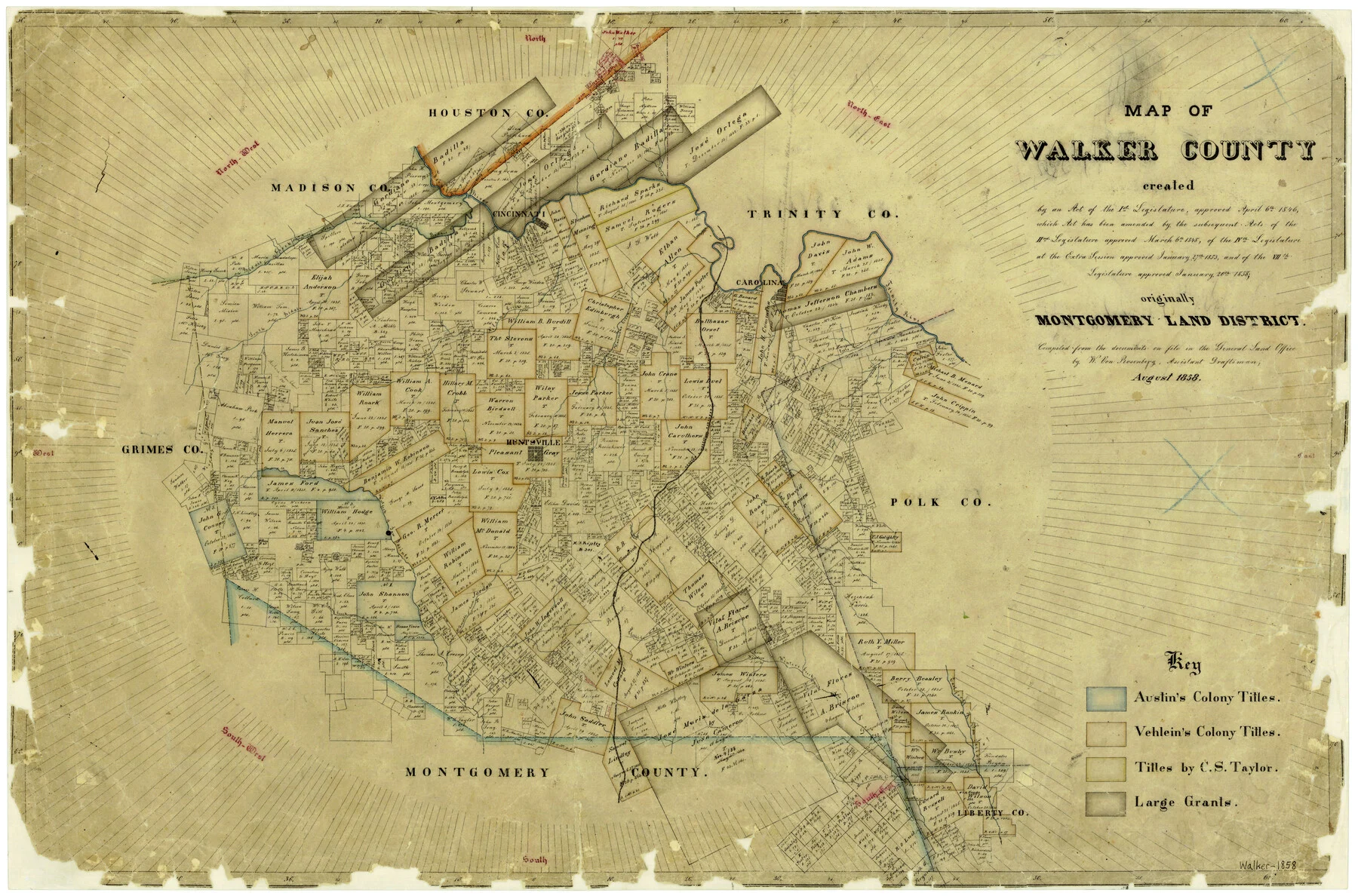
In April 1846 Walker County was established out of Montgomery County and a part of
 Houston County, and Huntsville was made the seat of government.